
A note from the Professor: Curiosity is a superpower — ask one better question today. — FREE SAT/ACT SEMINAR — ask us for details.

100+ Reviews10+ Years1,000+ StudentsIndependently VerifiedFounder-LedMethodology-DrivenLearner-CenteredLive or OnlineElite 1:1 Tutoring

Office / Our Picks

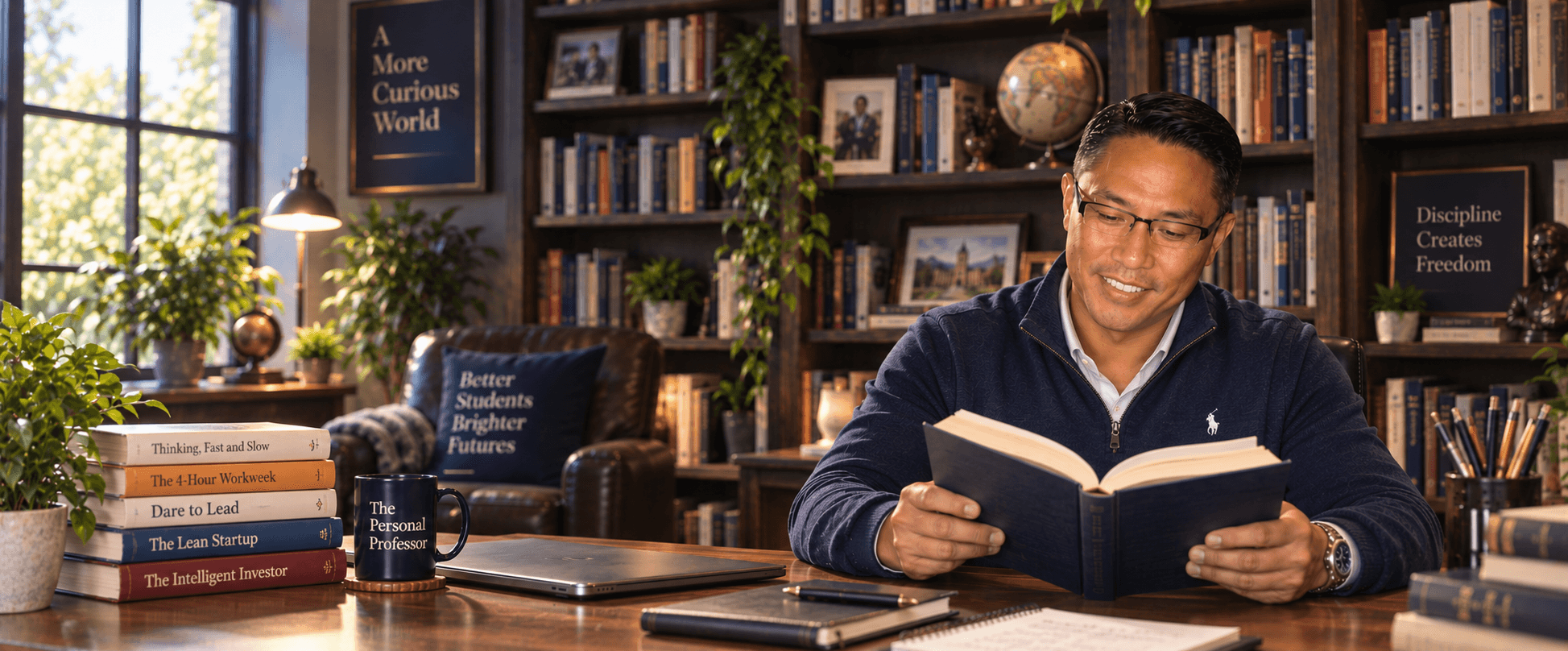
James in a brown sport coat, seated in his home library reading an open book, surrounded by bookshelves.

READ DEEPLY.
QUESTION BOLDLY.
THINK FOR YOURSELF.

The books we return to are the ones that challenge assumptions, sharpen our questions, and change how we understand learning. Our Picks brings together ideas that have influenced how we teach, how we think, and how we help students become increasingly independent thinkers.

Understanding Before Answers
Questions Create Insight
Productive Struggle Builds Mastery
Adapt to the Learner
Independence is the Goal

TPP PICKS: HOW A THINKER THINKS

The Socratic Method

A Practitioner's Handbook

Ward Farnsworth

2021

Author: Former Dean of the University of Texas School of Law (served 2012–2022) -- an author credential, not a book award.

Teaching Philosophy

A legal scholar dissects Socratic dialogue as a discipline: how patient, well-aimed questions expose hidden assumptions, sharpen definitions, and lead a thinker toward conclusions they arrive at themselves -- equal parts philosophy and practical toolkit for anyone who teaches, argues, or wants to think more carefully.

The Professor’s Take

“The best teacher in the room is not necessarily the person who can give you the answer fastest. Sometimes the better teacher asks the question that makes you discover the answer yourself. We don't just teach students to find an answer. We want them asking why the answer is true. That habit of questioning is where understanding begins.”

TPP PICKS: HOW A THINKER THINKS

The Scout Mindset

Why Some People See Things Clearly and Others Don't

Julia Galef

2021

Named one of The Wall Street Journal's best books of 2021.

Critical Thinking

Julia Galef contrasts two stances toward belief: defending territory versus mapping it honestly. Drawing on psychology and decision research, she argues that accuracy, not confidence, is what separates clear thinkers from everyone else, and shows how curiosity and intellectual honesty can be practiced like a skill.

The Professor’s Take

“Being intelligent does not help very much if we use all that intelligence defending what we already believe. I want students willing to ask, ‘What if I'm wrong?’ The goal shouldn't be to win an argument with reality. It should be to understand reality better. Truth-seeking requires curiosity, humility, and the courage to change your mind when the evidence changes.”

TPP PICKS: HOW A THINKER THINKS

Was Einstein Right?

Putting General Relativity to the Test

Clifford M. Will

Originally published 1986 • Updated edition 1993

1987 American Institute of Physics Science Writing Award.

Scientific Reasoning

Physicist Clifford Will narrates the decades of increasingly precise experiments that have tested general relativity against reality, showing how a revolutionary theory earns trust not through authority, but through surviving repeated, deliberate attempts to prove it wrong.

The Professor’s Take

“If Albert Einstein can be questioned, anyone can be questioned. That's not disrespect for expertise — it's respect for truth. A great idea should survive because evidence keeps supporting it, not because a famous person said it. I want students comfortable asking the dangerous question: ‘How do we know?’ Then I want them disciplined enough to follow the evidence wherever it leads.”

TPP PICKS: HOW A THINKER THINKS

The Structure of Scientific Revolutions

Thomas S. Kuhn

Originally published 1962 • 50th Anniversary Edition 2012

Landmark work in the history and philosophy of science.

Philosophy of Science

Kuhn's landmark work introduces "paradigm shifts" to describe how science advances not through steady accumulation but through periodic, disruptive reconceptions of the very questions worth asking -- a framework that still shapes how we talk about intellectual change today.

The Professor’s Take

“We should be careful with two opposite mistakes. One is rejecting established knowledge merely because questioning authority feels exciting. The other is treating today's consensus as though no better explanation could ever exist. Progress requires both discipline and courage: preserve what the evidence supports, but never become so comfortable with a framework that you stop noticing the evidence that doesn't fit.”

TPP PICKS: HOW A LEARNER LEARNS

Make It Stick

The Science of Successful Learning

Peter C. Brown, Henry L. Roediger III, and Mark A. McDaniel

2014

Learning Science

Cognitive scientists overturn the intuitive rules of studying, showing why rereading and highlighting feel productive but rarely stick, while spaced practice, self-testing, and mixing problem types feel harder yet build durable, transferable knowledge -- a rigorous, evidence-based case for embracing difficulty rather than smoothing it away.

The Professor’s Take

“One of the biggest mistakes we make in education is confusing familiarity with mastery. Rereading something until it looks familiar can feel like learning — right up until you have to produce the answer yourself. Real learning requires retrieval, application, and sometimes a little struggle. Difficulty is not always evidence that learning is failing. Sometimes it is evidence that learning is finally happening.”

TPP PICKS: HOW A LEARNER LEARNS

Why Don't Students Like School?

A Cognitive Scientist Answers Questions About How the Mind Works and What It Means for the Classroom

Daniel T. Willingham

Originally published 2009 • Second Edition 2021

Author: Daniel T. Willingham served on the National Board for Education Sciences during the Obama administration -- a policy credential, distinct from any award for this specific book.

Learning Science

Willingham answers nine deceptively simple questions about how children think and learn, reframing common classroom frustrations as predictable features of cognition rather than failures of character or effort.

The Professor’s Take

“When a student struggles, it is easy to label the problem: lazy, distracted, unmotivated, not a math person. Those labels are usually less useful than asking what is actually happening inside the learning process. Is the foundation missing? Is working memory overloaded? Is the challenge too easy, too hard, or simply presented the wrong way? Before judging the learner, understand the learner.”

TPP PICKS: HOW A LEARNER LEARNS

Outsmart Your Brain

Why Learning Is Hard and How You Can Make It Easy

Daniel T. Willingham

2023

Learning Science

Cognitive scientist Daniel Willingham explains why studying often feels productive without being effective, translating memory and attention research into concrete strategies students can actually use, while staying honest about why no single method works for every learner.

The Professor’s Take

“A student can work incredibly hard and still spend that effort on the wrong things. I see this all the time. More hours do not automatically produce more learning. Part of becoming a stronger student is learning how your own mind works — what deserves your attention, how to practice, how to test yourself, and how to recognize when you don't understand something as well as you thought you did.”

TPP PICKS: HOW A LEARNER LEARNS

Visible Learning: The Sequel

A Synthesis of Over 2,100 Meta-Analyses Relating to Achievement

John Hattie

2023

Education Research

John Hattie updates his massive synthesis of education research, ranking the interventions with the strongest evidence behind them and reminding readers that impact, not intention, should decide what a classroom actually does.

The Professor’s Take

“Education has no shortage of traditions, habits, theories, and strongly held opinions. But the question I keep coming back to is simpler: what is actually helping this student learn? Good teaching requires evidence, feedback, adjustment, and the willingness to change course. That is why our approach is built around watching progress and adapting instruction rather than blindly following a predetermined script.”

TPP PICKS: HOW A LEARNER LEARNS

Range

Why Generalists Triumph in a Specialized World

David Epstein

2019

Learning Science

David Epstein marshals evidence from sports, science, music, and business to challenge the cult of early specialization, arguing that breadth, sampling, and delayed focus often produce better long-term problem-solvers than narrow expertise acquired too soon.

The Professor’s Take

“Students are often encouraged to put knowledge into separate boxes — math over here, science over there, writing somewhere else. But some of our best thinking happens when ideas from different worlds collide. Learning broadly gives us more tools for solving unfamiliar problems. The connection you don't need today may be exactly the one that unlocks tomorrow's problem.”

TPP PICKS: HOW A LEARNER LEARNS

A Mathematician's Lament

How School Cheats Us Out of Our Most Fascinating and Imaginative Art Form

Paul Lockhart

2009

Mathematics Education

A working mathematician's provocative essay-turned-book argues that school mathematics has been drained of the curiosity and creativity that make the subject worth doing, and imagines what teaching math as an art form might actually look like.

The Professor’s Take

“Sometimes a student doesn't hate mathematics. They hate what mathematics has been reduced to. Math isn't supposed to be an endless collection of procedures someone else invented and you have to memorize. It is pattern, reasoning, imagination, and discovery. When students begin asking why something works instead of merely memorizing what to do next, mathematics starts becoming mathematics again.”

TPP PICKS: THINKING IN THE DIGITAL AGE

The Gutenberg Elegies

The Fate of Reading in an Electronic Age

Sven Birkerts

Originally published 1994 • Featured/revised edition 2006

Reading & Attention

Writing before smartphones or social media existed, Sven Birkerts worried aloud about what electronic culture might cost readers in interiority and contemplation -- an early, still-relevant meditation on the tradeoffs of a media transition that was only just beginning.

The Professor’s Take

“What makes this book fascinating today is that it raised the alarm before smartphones, TikTok, AI assistants, and most of the technologies we're now debating even existed. The details changed. The underlying question didn't: what happens to us when information keeps getting faster but contemplation keeps getting harder? Progress gives us new capabilities. Wisdom requires asking what those capabilities might quietly cost us.”

TPP PICKS: THINKING IN THE DIGITAL AGE

The Shallows

What the Internet Is Doing to Our Brains

Nicholas Carr

2010

Finalist, 2011 Pulitzer Prize for General Nonfiction.

Reading & Attention

Nicholas Carr's Pulitzer Prize-finalist argument traces how the internet's built-in incentives toward interruption and skimming may be reshaping attention and memory, questioning whether constant connectivity trades depth of thought for breadth of access.

The Professor’s Take

“The danger isn't that technology gives us too little information. It's that it gives us so much, so quickly, that we begin mistaking exposure for understanding. Knowing that an answer exists somewhere is not the same thing as knowing it. Search is extraordinarily powerful. But a search engine cannot build the structure inside your mind that allows you to recognize what an answer means.”

TPP PICKS: THINKING IN THE DIGITAL AGE

The Dumbest Generation

How the Digital Age Stupefies Young Americans and Jeopardizes Our Future

Mark Bauerlein

2008

Reading & Attention

Mark Bauerlein's deliberately provocative title frames a real question: what happens to a generation's intellectual habits when technology continuously competes for their attention? A useful foil for debating where genuine concern ends and generational complaint begins.

The Professor’s Take

“I don't believe this is a dumb generation. That's exactly why the problem concerns me. We have placed enormously powerful technology in front of enormously capable young minds and then designed much of that technology to interrupt them, entertain them, and compete for every spare second of attention. The question isn't whether today's students are intelligent. They are. The question is whether we're building an environment that gives that intelligence enough uninterrupted time to develop.”

TPP PICKS: THINKING IN THE DIGITAL AGE

Reader, Come Home

The Reading Brain in a Digital World

Maryanne Wolf

2018

Reading & Attention

Cognitive neuroscientist Maryanne Wolf examines what happens to the reading brain as screens replace print, weighing genuine benefits of digital reading against the quieter cognitive habits -- patience, reflection, deep attention -- that sustained reading uniquely builds.

The Professor’s Take

“We have access to more information than any generation in history, and I'm not convinced that means we're understanding more. We scroll, skim, swipe, summarize, and move on. But comprehension requires something technology increasingly encourages us to avoid: sustained attention. Reading deeply means staying with an idea long enough to understand it, question it, connect it, and sometimes struggle with it. If we lose that ability, having the world's information in our pocket won't make us smarter. It may simply make us faster at not thinking about it.”

TPP PICKS: THINKING IN THE DIGITAL AGE

Teaching with AI

A Practical Guide to a New Era of Human Learning

José Antonio Bowen and C. Edward Watson

Second Edition • 2025

AI & Education

A practical field guide for educators navigating generative AI in the classroom, covering everything from redesigning assignments to verifying AI-assisted work, with an emphasis on using the technology to deepen student thinking rather than quietly replace it.

The Professor’s Take

“AI is neither the savior of education nor the end of education. It is a remarkably powerful tool — which means how we use it matters. I want students using AI to extend their thinking, challenge their assumptions, explore ideas, and become more capable. I worry when it becomes a substitute for the very struggle through which thinking develops. Technology should amplify intelligence, not outsource it.”

1 / 15

Personalized PlanNo Long-Term ContractTPP Satisfaction CommitmentOne Dedicated ProfessorThe Nexus MethodProgress MeasuredRight-Sized

Independently Verified Reviews

Rated 5 out of 5 stars

From www.tutors.com Since 2015

We made a really aggressive plan for the last tests and final exam, and I went from failing the class to earning an A.
The results were remarkable: Daniel went from failing geometry to earning an A and demonstrated that he was ready for the higher math track.
James was a huge help—flexible, easy to work with, and gave feedback that really improved my writing.